
When exploring a new area and looking for suitable camping spots we have a short list of criteria we ideally want:
1) Flat.
2) Open enough for solar to work.
3) Close enough to a cell tower to get a usable signal.
4) The desire to not see, smell or hear humanity.
5) Spots outside hunting/shooting areas.
#1, a portion of flat ground is just to make setting up camp and sleeping comfortably easier. #2, good solar coverage with minimal shading keeps electronic devices (laptop, tablet, cell phone, electric toothbrush, headlamp etc) charged up and most importantly keeps our fridge/freezer running and allows us to store more food and beverages longer for extended outings. #3, is so we have the ability to send and receive texts, calls and get Internet access so we can stay in touch with family and friends and up to date with all the news and ridiculous things Republicans are doing to allow their corporate overlords to destroy these beautiful places we like to spend time in. #4, a desire to not be around those who like to make noise and dust with ATV’s, who blast music at inappropriate times, run generators at all hours and shoot trees and garbage they then neglect to clean up. I like peace and quiet and hearing the wild area we are in and it’s inhabitants. I think that is self-explanatory. So too is #5, finding spots outside the area that is presently open to hunting (if relevant), especially if it is designated a “Any legal weapon” hunt (in Oregon), which most importantly for Gia means loud, scary rifles. So that presents me with another obligation to not have my dog trembling uncontrollably and wanting nothing but be in the Tacoma’s camper shell, all closed up with a Bluetooth speaker inside playing loud-ish hard rock to conceal the sounds of gunfire. It really is not to much to ask.
But… finding a spot that meets all five of those criteria is hard. Finding a spot that meets criteria 1, 2, 4 and 5 usually means #3 is not easily achievable and, in the past, we spend a shorter amount of time in those spots even though they are good because we are completely out of touch with…everything. Early on I did get a cell phone signal booster/amplifier and a Wilson directional antenna so if there is even the hint of a cell signal we could find it, connect to it, boost it and make it usable, even if only barely, like old-school 14.4 bit/s modem speeds. I later tried an omni-directional antenna so that I didn’t have to spend 10 minutes each setup looking at my cell phone’s signal strength meter while turning the directional antenna in small degree arcs and waiting to see which direction the strongest signal was coming from. The other minus with using that setup was that the phone had to be sitting in the amplifier’s cradle and was not usable as a regular phone. Plus, I use devices other than the phone and they want Internet access too which could not be done unless the phone has the ability to create a wireless access point to broadcast the wi-fi signal created from the cell signal. Annnd, of course, AT&T, being the bottom-tier company that they are they don’t allow “tethering” from your phone without paying extra and then they only allowed some stupidly small amount of data to be used over tethering. To solve that problem I have been unlocking bootloaders and rooting my phones and running AOSP ROMs (which usually allow tethering by removing the software flag that tells the carrier “tethering is ON”). I originally starting with CyanogenMod and then when that imploded I switched to the fork and spiritual continuation of that project called LineageOS and have used various versions of that for over 10 years. This setup worked fine but obviously had its limitations and annoyances.
Then a few years ago I heard of Starlink and the idea sounded promising. Their offerings were too physically big and too expensive early on and I decided to bide my time and see what improvements happened over time. Eventually, about a year ago I saw the new Roam plans and newer, cheaper, smaller hardware which seemed to be about the right option for my use scenario. But I still waited, mostly because Elon Musk became a crazy fascist oligarch more interested in spending hundreds of millions of dollars to prop up the useful idiot Donald Dump and his enablers than paying taxes or doing anything…”good” for humanity with his riches. He’s a douche. I decided to never support Tesla as a general middle finger towards him and if there was any way to get the same sort of connectivity as a Starlink I would sooner use that. But, sadly, the next portable LEO satellite-based system in the pipeline (but not a viable service for several more years supposedly) was Kuiper Systems (now rebranded as Amazon Leo) owned by yet another oligarch douche, Jeff Bezos so….
But being me and wanting it all (finding a camping spot that meets all five criteria) and now having the availability of a viable solution…I still waited about another 6 months until I was able to handle, install and use the newer Starlink Mini at a friend’s ranch in the middle of nowhere Humboldt County, CA. My Internet needs are humble. My activities do not include video conferencing or online gaming (or any other activity where symmetric speeds are needed). It is a heavily asymmetric workflow which is where a LEO satellite system works fine.
I had used the original Starlink system at this same location before and it worked fine but I noticed that heavy rain, hail or snow caused an easily noticeable and even substantial reduction in speeds. For short(er) periods of time to actually being unusable. This version was also effected by any of those precipitation types and heat (~40 C/104 F) as well seemed problematic. It was initially installed atop a T-post with the included adapter.
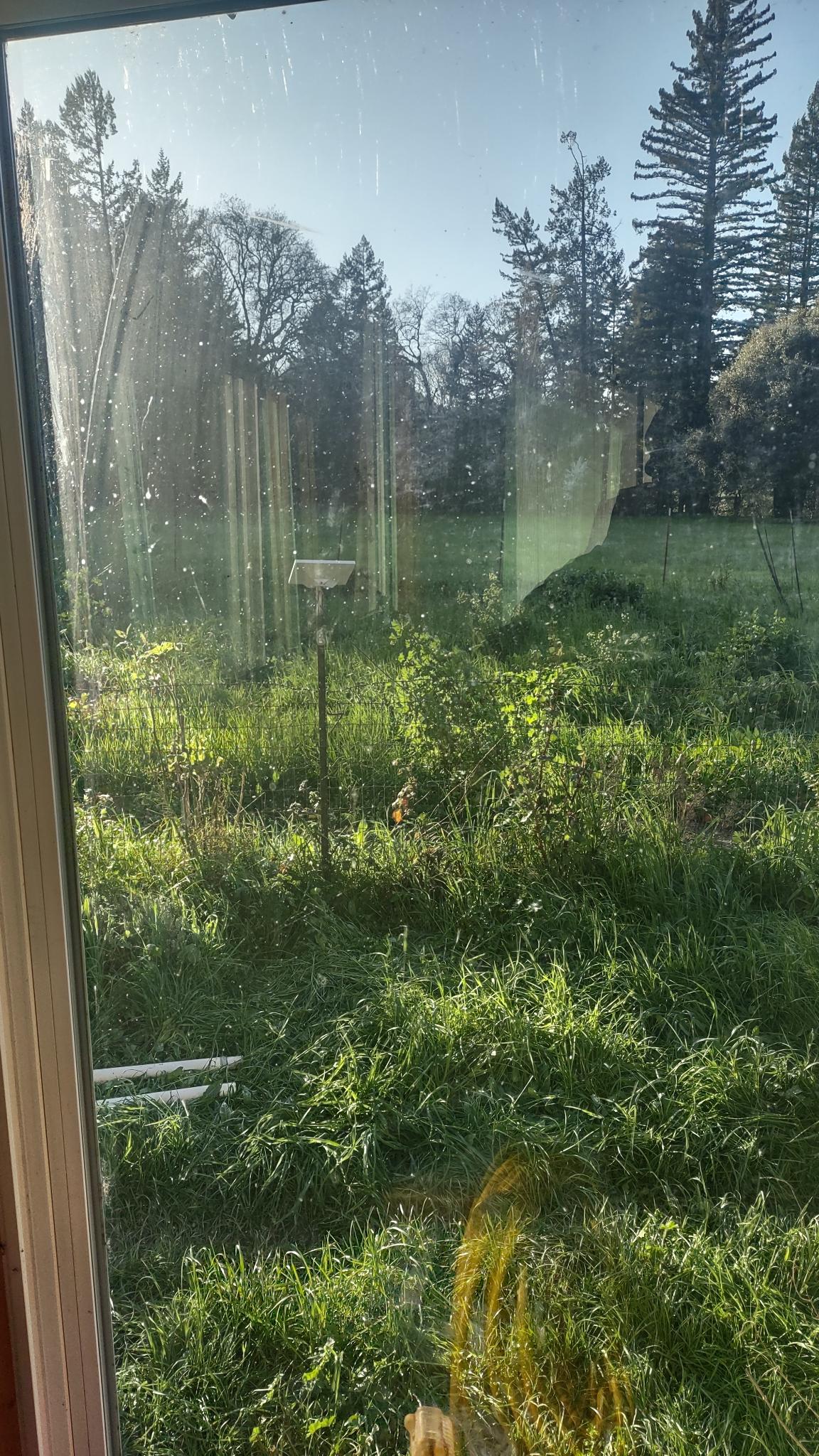
Having a lot of whatever form of RF-absorbing water molecules filling the sky between satellite and the little dish much less sitting on the dish and degrading the signal between those two is understandable from a physics standpoint. The heat was a little different and I just think sitting out in direct, blazing sunlight on a breeze-free day overheated one or more components inside the case and caused it to reboot itself…on more than one occasion. So I unscrewed it from the post and brought it over to a shaded table outside and the problem vanished.

During months of use I never came across any substantial annoyances that were directly attributable to the Starlink. On those times it completely stopped working and the wireless network it provides just vanished I could check the Starlink app and found it was usually due to a software update to either the Starlink itself or its internal router. Sometimes daily updates. The app allowed me to select a time window where those updates would be preferred and once I changed that to “Overnight” that shortcoming never effected me again.

Sometimes it slowed more than I would have liked during good weather but it was still usable. I’m sure part of that blame lies with my normal use of a quality VPN which noticeably slows down any type of broadband I have ever used including fiber. Adding in physical distance and the related latency penalties along with the extra VPN hops certainly takes its toll. I guess privacy and security matter slightly more to me than outright speed. I was also not able to ever use “regular” texting (through the carrier) although the vast majority of my contacts and I use Signal which worked flawlessly. Only a handful of my contacts don’t use Signal but neither do businesses and government agencies. So for now, when I am truly off the grid I face the loss of cellular-based connectivity services but I at least have regular Internet access. So that’s taking care of half of #3.
So now knowing enough about its usefulness and shortcomings I went and bought the Starlink Mini Kit. To make me feel a bit better about my slight support of the MuskRat by buying his hardware and service I have made a small donation to the Cards Against Humanity people and their fight with Space X over a piece of property in Texas that they own and Space X illegally despoiled. The fact that link works tickles me to no end.

Once the kit arrived it was a simple unboxing and plugging in the two ends of the 15 meter long power cable to the Starlink itself and to the AC adapter. It takes a couple of minutes on boot to figure out where it is, where it is pointing at the sky, if there are any obstructions and if it is aligned correctly. Once the Starlink and its internal wireless router are both up and running you connect to its wireless network and do all the Internet things you want or need to do. You can launch the Starlink app and check if your alignment can be improved which you do by physically turning the Starlink until the app say all is good. It takes about an hour for the Starlink to fully map any obstructions within its 110 degree field of view. Eventually it will show you a graphical representation of the portion of a sphere that its signal is covering and what portions of that sphere (if any) are impacted by obstructions. I have seen upwards of 10% obstructions with the corresponding message in the app saying, essentially, “You have some obstructions but we don’t think it will impact the service noticeably.”
When I was about ready to buy the kit I was told the cheapest Roam package price was $50 for 100GB of data. When I finally went and bought it that price had gone up to $55. Having used that plan for less than two months I am coming to the realization that only 100GB of data is cramping my style. In the first full month of usage I ran out about 3 days before the next billing period. For those remaining days I was forced to use the included and unlimited “low-speed data” which was like going back to the time of screeching modem dial-up and the glacially slow speeds. It still worked, barely, but my normal workflow running numerous browser tabs and having background downloads came to an abrupt halt. It was “usable” if I only did one task at a time and then it was still annoyingly slow. I am on the second month on that same plan and I expect to end up disappointed again so I am resigning myself that I am going to have to move to the next data plan which is 300GB of data a month for $80. UPDATE: I have now been using the mid-tier, $80, 300GB plan for a month and it is going to meet my bandwidth and data needs with room to spare.
When my friend in Humboldt got his mini less than a year before I got mine he got the “Unlimited Data” plan for under $90.

That plan has now doubled to $175 which is not going to happen on my budget.

Besides the Starlink itself I have purchased two additional items for it. The first was a padded carrying case, through eBay, from a guy in Ukraine. I found his direct link after I had already purchased through eBay. Oh well. After the several week wait for it to arrive all the way from a war zone it seems built well, everything fits snuggly, and I can simply pack it with my other Starlink-related stuff or mount it on a Molle panel out of the way.

The other additional item is a battery pack that actually attaches to the bottom side of Starlink itself. When attached to the Starlink everything still fits in the protective bag.
 I can charge the battery with a USB-C cable or the power cable that comes with the Starlink. It also has a magnetic charging port which is a great help with with both me and a dog shuffling around it and unintentionally kicking or tripping on the cable.


 If the cable was attached through the regular power port and either of us caught it with a foot I can imagine damage to both the cable and the port. The battery also has a standard 1/4″ Screw Hole built-in to mount a tripod which helps keep it off the ground a bit and makes aiming it easier.

The battery has a browser-based app which you can connect to via Bluetooth or Wi-Fi which shows every parameter you might want and can control numerous settings. All the information on the front screen can be seen through the app which is nice and keeps me getting up more than a few times to walk over to the Starlink and see how much power I have left to play with.
So, for now, with about $600 dollars total into this new tool (with the added monthly expense as well) it seems to be mostly meeting my needs. Time will tell how well the various components hold up under our not entirely gentle use and handling. I will update this post with any new developments over time. I am now looking forward to revisiting some of the spots Willow and I visited where there was no Internet access and we couldn’t stay more than a couple of days. And now I feel comfortable undertaking some more extensive exploration and see if we can find some nice new spots, further out and away from civilization that can now meet 4.5 of my 5 ideal campsite criteria.
Wish us luck.
